"I have been a wanderer among distant fields. I have sailed down mighty rivers." -Percy Bysshe Shelley
We left the dry, oven heat of Madrid for the balmy, humid heat of the Mediterranean port, Barcelona. We start every new city off with a search for a local market to stock up on groceries. We bought enough food at the most recent stop to earn a free bottle of wine. The cashier couldn't understand why I didn't want it, so I finally convinced the woman behind us in line that I really did want to give it to her as a gift. She probably had stories to tell about the crazy American lady throwing away perfectly good vino.
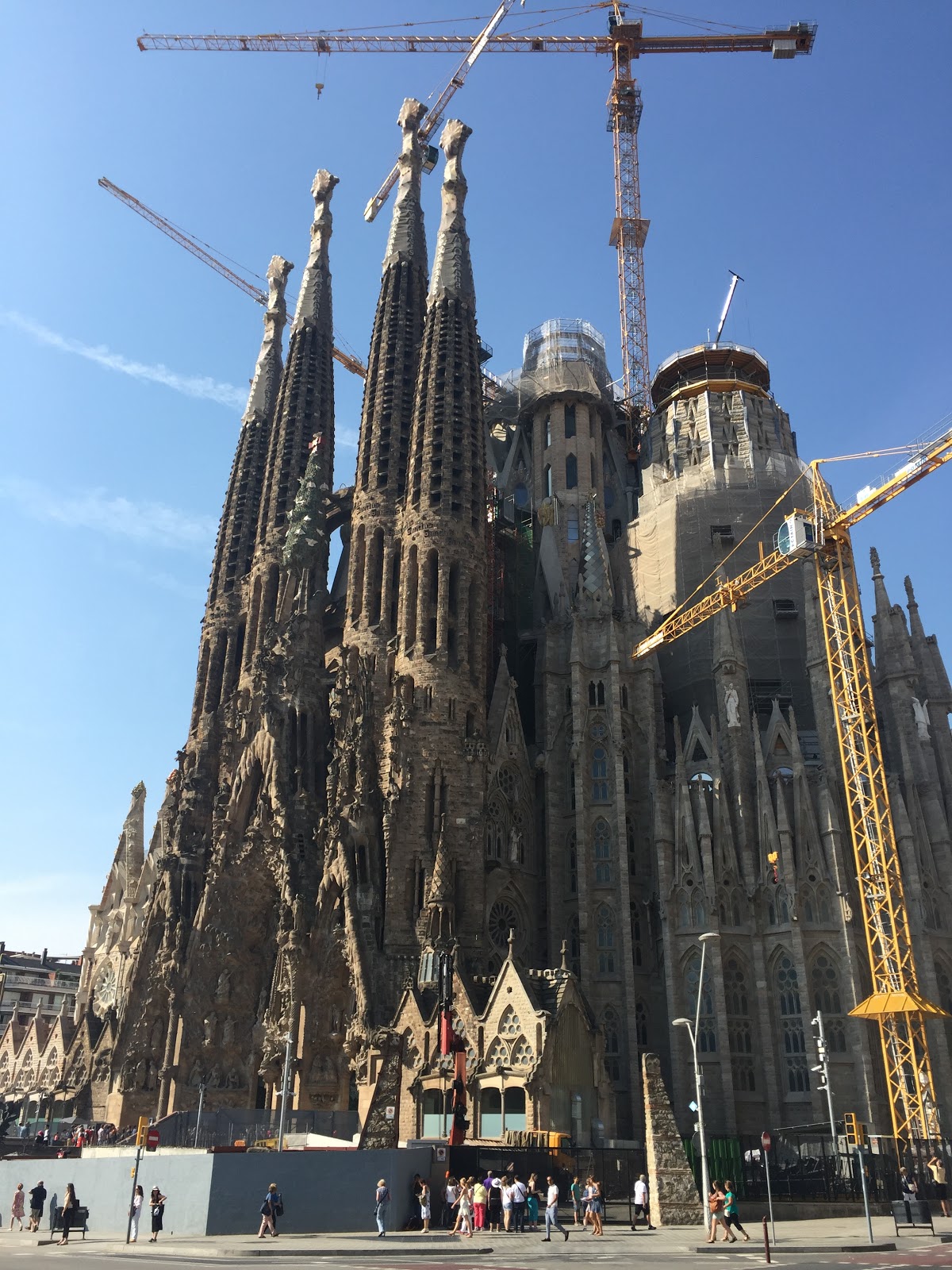
We began our Barcelona touring with La Sagrada Familia, Gaudi's 131-year-old continuing project. Definitely the highlight of our trip so far, it is so different from any other cathedral architecture that it can't even really be compared. Being there was incredibly moving. I feel that Gaudi was an artist and a genius, but also devout and inspired to design a structure that paid tribute to the Creator. Although he worked on it for the last 40 years of his life, Gaudi understood he would never see its completion. His work seems to me not about ego but about devotion. The Nativity Facade where you enter, done in the "Modernisma" style is intricately detailed, ornamented with sculptures from nature along with the traditional elements of the Nativity story, emphasizing that all creation witnesses the glory of God. The colors are mostly earth tones outside with pops of color, but as you walk inside you feel like you've entered a colorful rain-forest. As Anna said, "It's like walking into a pop-up book." The light from the stained-glass windows creates a feeling of a tree canopy to the interior. We watched an informational video about the cathedral and wandered around in awe before exiting the opposite side to look at the western "Passion" facade. The sculpture of the story of Christ's last week is done by a contemporary artist and is powerful and symbolic. We spent a long time figuring out the different parts of the story as told in angular and chiseled forms -- from Judas's kiss of betrayal to Peter's denial to the agony of Golgotha, the artist captures so much emotion in a modern and un-cluttered aesthetic. We spent more than 2 hours at the cathedral, and have found ourselves taking walks there in the evenings to enjoy the exteriors again almost every night. It seems improbable that it will be completed by the projected 2026 100th anniversary of Gaudi's death. But if it is, I certainly hope to return to see the finished work.
In the afternoon, we decided to see more of Gaudi's civic sculpture at the Parc Guell. Luckily we didn't go there during the hottest part of an extremely hot day...oh wait, that's exactly what we did. Despite the heavy, humid heat, we found the park whimsical and an interesting look into another aspect of Gaudi's creative expression. He created walkways designed to be like the interior of a surfer's wave, wavy benches that are ergonomically comfortable to sit in, and aqueducts that were practical and also artistic.
On Friday, we headed downtown to Plaza de Catalunya to go on a Barcelona City Walk. We listened to an audio recording and walked around for about 90 minutes, learning about famous and important spots in both old and new Barcelona. We saw the "layers" of the city from the Roman foundations including parts of a temple to Caesar, the medieval layer including the Cathedral and other Gothic architecture, the modernisma and early Picasso-era sights and the modern layer of commerce and resurgence of "Catalan" culture. Repressed during the Franco Era, Barcelona as the center of Catalunya is like the "Ireland of Spain." Their language was forbidden during the Franco regime, so now all schools are conducted in Catalan -- tricky for us since we were beginning to feel at least competent with our Spanish. They fly more Barcelona flags than Spanish ones, and even provocative flags that include the star from Cuba's flag -- a message that independent Cuba was able to break away from Spain. We finished the walk and back-tracked to "Las Ramblas" to find lunch in "La Boqueria." We have all enjoyed these markets and the "treasure hunt" of finding our own lunches in the stalls. We followed lunch with a visit to Barcelona's Picasso Museum. Exiled of his own will while his native Spain was under Fascist control, most of Picasso's work is in France and other museums. However, this is the best collection of his early work as he began his study here. Some of his later work has found its way back to Barcelona in this collection as well. It was a great tour, and we especially enjoyed his "Las Meninas" Collection. Having had the privilege of seeing Velazquez's original in Madrid just days before, we found Picasso's obsessive studies of the work fascinating. It was also informative to see Picasso's early experimentation in many different styles.
After a long, hot day, we took a much-needed rest back at our apartment then headed to Montjuic in the evening. We took the "funicular" up the hillside and then rode in a cable car to the top of the hill where the castle-fortress is located. Then we took a wandering, down-hill stroll back to town passing museums, the 1992 Olympic Stadium, parks, fountains, 1929 World Fair buildings, and the old Bullfighting Ring-turned mall.
Sunday, we attended church at the local building and found it to be a bustling and crowded facility with 3 wards. We could barely find a place to sit. Two full-time missionaries spoke; I find I can keep up better with their Spanish than with the natives. They did a great job. It occurred to me while listening to them in a way it never has before what an act of faith and humility it is to serve a mission in an unfamiliar language. We spoke to a few other missionaries after the meeting who knew Hermana Seattle Sperry from our hometown and told them to pass on a hello from her former "Ma and Pa." The rest of the day we took a much needed rest. Some of my children may not be used to the marathon pace of their mother. In the evening, Cory and I strolled down to the Sagrada Familia again and ran into 2 more sister missionaries on the street who were thrilled to know we knew Hermana Sperry and showed us pictures they had taken with her just a few days earlier.
Monday, when we'd eaten breakfast and gotten ready, we headed to the beach! Anna was thrilled. She LOVES being in the water and has been missing her summer swimming. Cory and I started off with a run along the boardwalk. Barcelona isn't a "runner-friendly" place so we decided to take advantage of a straight, traffic-free running surface. It was so hot and humid that you could wring our clothes out by the end, but we got it done. We enjoyed the day splashing and floating in the salty Mediterranean, and ate a fancy seafood lunch at a restaurant on the beach. We all got sunburns of one degree or another, but there's nothing like the beach to lift everyone's spirits. Anna said it was her best day of the trip so far. Sun-burned, and sun-tired, we headed home to clean up and pack up.
Rule #1 Travel Quotes
"Once a year, go some place you've never been before."
Dalai Lama
Monday, June 19, 2017
Thursday, June 15, 2017
Somos Madrilenos
"Do not go where the path may lead; go instead where there is no path and leave a trail." -Ralph Waldo Emerson
Arriving at our second stop, Madrid, made me grateful we hadn't started here. Small-ish Seville was much less overwhelming than this city of 5 million. (By the way, I think I should just warn you that I'm not fact-checking anything in this blog. You're going to have to take my word for it as well as my short-term memory of constantly flowing dates, people and places.) Madrid is like a hot, smoky New York City minus the giant skyscrapers. It's full of wild traffic, buildings as far as the eye can see, sidewalks flowing with humanity, and about a million dogs.
Our first full day in the city, we toured the Puerta del Sol/Plaza Mayor area -- the downtown, Times Square-like center. With a free audio-tour, we learned the major historical highlights -- information about more or less enlightened royal and civic leaders (Charles 3rd "the first mayor of Madrid" to Franco the Fascist bad-guy); major social events (assassination attempts, New Years' Eve Festivities, the Spanish Inquisition); and important buildings (post-office-turned town hall, cathedral, and royal palace). Our favorite parts of the tour:
-Devouring napolitanas at La Mallorquina (croissant-like pastries filled with chocolate, cream, or ham and cheese).
-Buying cookies from cloistered nuns. (You ring a bell at an ancient door, travel down a stone hallway, place your money on a turn-table lazy-Susan, and out come 1/2 kilo of cookies. Seriously cool experience. Even though we accidentally knocked on the wrong door at first. Sorry, Madrilena Stranger.)
-Learning about St. Isidore, the humble farmer who became a revered patron Saint through choosing just to live a devout and worthy life.
-The museum of Raton Perez -- Spain's "Mickey Mouse" who is the tooth fairy to excited Spanish children with teeth under pillows.
-Mercado San Miguel, the outdoor market where for fun we gave everyone 10 euros to visit stalls and buy their own lunches. Some stuck with traditional ham and cheese. Noah went adventurous and sampled sea urchin, octopus, and cod ceviche. I finally got to taste the excellent Spanish olives.
-Discovering Gine Chocolateria, the 24 hour bastion of chocolate con churros. Though full, we returned there in the evening and indulged our chocolate and pastry annual quota.
After lunch, we toured the Royal Palace. It's the 3rd largest palace in Europe behind Versailles in France and Schonbrunn in Vienna. Having been to Vienna, I can only compare it to that. This palace seemed in far better condition of restoration. The interiors are opulent, stunning, and full of splendors as you would expect. The Royal Family has a hobby of collecting clocks, so it was fun to find the outrageous and extravagant clocks in every room. Sure, this kind of thing leads to revolutions, but boy were they cool. The frescoe design of Tolomeo are works of true genius. Isaac tried to get photos, but got shut down fairly quickly by security. I guess there's a reason it seems so well-maintained.
The next two days were devoted to the great art museums of Madrid. If you're not an art fan, you have my blessing to skip the next two paragraphs.
El Prado houses the classic art collection. A crash-course in Art History, we traveled through the photo-realism of Rafael and the Italians, through the Flemish masters, up to the work of the the Proto-Modern Goya. We saw so many of the paintings I've learned about in Humanities and History classes that it's hard to pick a few favorites. I loved Van der Weyden's "Descent from the Cross," Bosch's triptych, "The Garden of Earthly Delights," (totally trippy), and El Greco's "Knight with His Hand on His Chest" was iconic. Anna's favorite was Velasquez's "Las Meninas" and I have to agree that seeing it in full-size makes you feel like you can actually walk into the painting. We walked a whole corridor of Rubens and Titian as well as the early Court-commissioned artwork of Goya. We then followed Goya's work as he became what many consider the Father of Modern Art, or the first artist with a Social conscience. His political "3rd of May" prompted my most visceral reaction. This was followed by his "black paintings." Artwork that he painted without commission on the walls of his home, it is deeply disturbing -- portraits of nightmares. The Goya collection was for me the most emotional part of the museum.
El Sofia Reina is Spain's Modern Art Museum. We started with its most famous artist and his most famous painting -- Picasso's "Guernica." I still can't believe we really saw it! I enjoyed explaining the historical significance of the work and seeing my teenagers experience it. We followed Picasso by picking up Proto-Modern Goya from the day before, traveling through cubism to surrealism, to abstract, to flat-out kooky. We saw works by many of the biggies -- Goya, Dali, Braque, Leger, Gris, Kandinsky, Pollock, Miro. And we were surprised to discover that it turns out Cory is the family aficionado! He even explained some the more obscure relevance of things to us. I knew I'd married a Renaissance Man. The kids, although having enjoyed Guernica, mostly thought most of the art was weird. We had some good chuckles for sure. Our favorite painting wasn't really a painting, but the title of a painting: "The Victors of Leningrad supported by the Colour-Blind Monster Matisse." Go ahead, look it up!
Cory picked up the family's first (and hopefully last) case of food-poisoning, but got through it in time to enjoy our last night in Madrid. We took our "Paseo" back to the city center to see the crazy night-life, eat tapas and pick up one last pastry. A fitting farewell to the Spanish Capital.
Sunday, June 11, 2017
Sevilla
"Adventure is worthwhile." -Amelia Earhart
The airport in Seville is tiny, but our taxi drivers were waiting for us when we arrived. An adventure of crazy turns, instant merging, and near-misses landed us at our first AirBNB. It felt like a complete act of faith to get out in a back alley with all of our belongings and hope someone would be there to meet us, but someone was there. She spoke to us in quick Spanish, handed us some keys, and left with her darling baby. We settled our things, and wandered a true maze of "streets" and alleys in search of "Mercado Comida." We finally found a Spar Express and loaded up with simple-to-fix meal staples ... and Diet Coke. We planned this leg of the trip for Spain to avoid the height of the summer heat, but it's definitely hot enough already. We snacked for dinner and held out on the jet lag until around 6:30 before giving up and going to bed.
Some us more rested than others, we struck out in the morning to the Barrio Santa Cruz. We took a self-guided tour through a labyrinth of what once was the Jewish neighborhood until the Inquisition expelled all Juderia from Spain in the 15th Century. What's left of those ancient lanes is a charming, touristy tangle of "kissing lanes" (streets so close together, you can lean out one window and kiss your neighbor across the street).
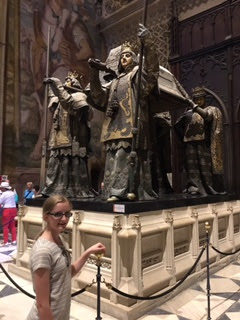
We finished up just as the Seville Cathedral opened. I don't know that I went in with expectations exactly, but this place surpassed anything I could have imagined. It's the largest Gothic Cathedral in the world; something I didn't totally understand from being outside it. When we entered through a tiny entry, all of us literally gasped. It is MONSTROUS inside. Literally an entire village could fit here. The main pillars scattered throughout are more massive in circumference than the giant redwoods. Some highlights for me include the high altarpiece that is covered with an expansive sculptured and gilded sequence of the life of Christ; being up close and personal to art masterpieces by Degas and Murillo; the tomb of Christopher Columbus. He had been buried as he wished in the Dominican Republic, but when that country finally were granted independence, they sent his remains back to Seville. We had anticipated climbing the Giraldo Tower, but unfortunately discovered it was closed. This tower is what remains of the former mosque where the cathedral was built, and from its height, the muezzin called all to prayer.
We followed the cathedral with paella in the Barrio. Isaac's limited Spanish resulted in rather more seafood in his paella than he would have preferred. By then, many of us had hit a wall so we returned to the apartment for Siesta.
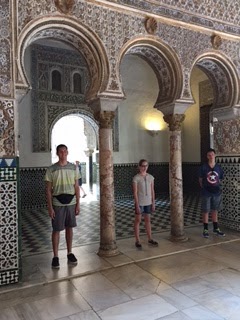
We next headed to The Real Alcazar for a late-afternoon tour. This is the palace of the Royal Spanish Family, and where Columbus was received by Queen Isabel. The palace was built by ejected Muslim Moors for Christian Spaniards. What results is a stunning combination of two different techniques, themes, and craftsmanship. The Muslim workmen worked Muslim ideologies into the design in subtle and sneaky ways...prayers to Allah among other things. The stone and tile used keep the palace impressively cool despite the Spanish summer heat. Following our tour, we wandered through the connected gardens that were suitably impressive in a palm-frond, desert-oasis way. Highlights of the palace were the room of massive tapestries, the reflecting pool in the courtyard, and Anna being chased by a peacock guarding her adorable chick. My mistake, a pea-hen. As we were leaving, we caught a glimpse of a beautiful bride in a chic wedding photo shoot.
In the evening, we wandered up to our roof just to see the sunset and were surprised to discover a pilgrimage processional emerging into the street at the small church across from us. A religious procession of ox-pulled carriage covered in lights was led by a Priest when the suddenly appearing crowd of pilgrims sang together "Salva Me" in glorious harmony. Something you can't plan into an itinerary; a magical moment. After a song and words from the Priest, the Pilgrims disappeared as suddenly and mysteriously as they had come.
The following day brought us to a tour of a real and working Bull-fighting ring. The grounds are perfectly groomed red dirt, especially impressive considering there had been a show the previous evening. The tour was professional although a little detached. I'm not sure what I think of this cultural tradition on an ethical level, but it was interesting to learn the history and culture behind it. For all I know, Spaniards might not approve of Mixed Martial Fighting, American ecological disregard, or consumption and waste either.
In the evening we attended a Flamenco Concert. Passionate, professional, mesmerizing. It's easy to hear how Moorish chants and calls to prayer have influenced this cultural style in the same way African-American experience and music contributes to the evolution and development of Jazz. We explored across the Guadalquivir River the up-and-coming hipster neighborhood of Triana and ate lots of pastries including Spanish churros.
Our last full day in Seville landed on Anna's 13th birthday; maybe the strangest birthday she'll ever know. We explored Maria Luisa Park and Plaza de Espana in the morning. The plaza is the site of the 1929 World Fair for all Spanish-speaking nations. My favorite part was the series of tile-works that display a map and mosaic for each region of Spain.
We have learned to avoid the heat of the day and spent the afternoon packing, doing laundry and playing cards before heading out for an evening "paseo" through the shopping district. We landed at a recommended Tapas bar at 8:00 for dinner to discover we were much too early for Spanish culture...they didn't open until 8:30. Even when we came back, we were the only ones there and they didn't get around to taking our order until closer to 9. The food was worth the wait. Our mediocre Spanish translation of the menu led to a few surprises when the food arrived, but all of it was delicious. As we paid the check, the server brought us little vials of a treat that I sipped and discovered was limoncello. Oops! Sorry, Bishop; I erred in ignorance and prevented the rest of my family from imbibing. When they serve your now 13-year-old complimentary aperitifs, you know you're not in America anymore.
Sunday morning, armed with an address and little else, we tracked down a couple of taxis to drop us at the local ward. We had to walk around the block to actually figure out where it was, but after the ornate style of the many churches in Seville, we instantly recognized the simpler LDS-style building. Though we understood very little of the meeting, it was all familiar and we at least knew the tunes of the hymns; I enjoyed singing them in the purer vowels of Spanish. We navigated the way home Amazing-Race-style, and finished packing and loading up before our taxis to the Train Station arrived.
Adios Sevilla!
Subscribe to:
Posts (Atom)